


 Library Management Software PHP
Discover 9 library management software packages written in PHP. These PHP scripts can be used to manage a collection. All items are created by our community of developers and designers.
 Scripts & Code11
 AngularJS2
 C & C++142
 C#56
C#56 CSS28
CSS28 Django0
 Golang15
 Java212
 JavaScript134
 NodeJS2748PHP Scripts8
 Ads78AI41Affiliate62Booking32Blog24Chat6Countdown58CMS35CRM17Directory21Database81eCommerce122Finance19Food55Forms12Forum70Games2GPS42Help Desk50Links248Multimedia82Login270Management93Business22Healthcare18HR47Inventory9Library8Property 22Restaurant51School17Mail90Marketplace17News7Newsletter62POS38Payment19Polls32Project Management99SaaS20Search51Security87Social Networking15Sport6Statistics37Uploaders42Website Builders639Miscellaneous95
 Python90
 ReactJS1
 Ruby28
 VB.NET7560
 App Templates2451
 Themes1060
 Plugins14157
 Graphics




Library Management Software PHP Scripts for Books, Members & Lending
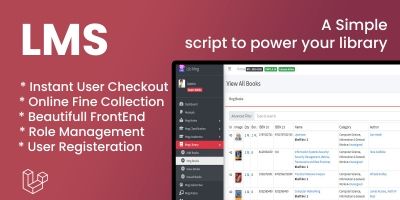
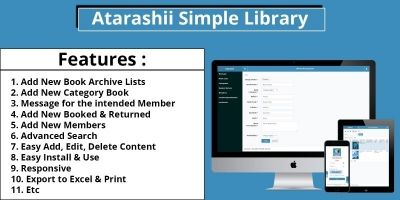
The Library Management Software PHP category is all about looking after books and readers. Here you’ll find complete library management system PHP scripts, lightweight book catalog tools and personal publication libraries. They cover the day-to-day work of a library: cataloguing, lending, returns, fines and member management.
If you prefer to start from solutions that other buyers are already using, take a look at the Top 20 Library Management Software PHP page. That overview highlights popular systems such as multi-purpose library scripts, barcode-enabled library management systems and personal library tools for managing books, films or publications.
Most scripts in this category follow a similar idea: replace paper cards and spreadsheets with a structured online library management system. Typically you get one side for librarians (admin) and another side for members or students, plus reports so management can see what is on the shelves and what is currently on loan.
Features you’ll often see in these library management software PHP scripts:
- Book and media catalogues with authors, categories, ISBN and status.
- Member management for students, staff, or public patrons.
- Issue, renew and return workflows with due dates and fines.
- Barcode support for faster check-in/check-out.
- Simple reports on loans, overdues and collection statistics.
- Sometimes a small “digital library” section for PDFs or media files.
Where these scripts fit in your PHP stack
Libraries rarely operate in isolation. In schools and colleges, a library system often sits alongside a wider school ERP or student information system. That’s why this category is closely related to School Management Software PHP Scripts and the broader PHP Management Scripts section. Everything runs on PHP and a database like MySQL, so it’s possible to connect login, student records or fee details between systems if you need to.
For public or special libraries that are part of a bigger organisation, it can also make sense to combine a library script from this page with a more general business or admin backend from Business Management Software PHP Scripts . In that setup, the library system handles books and members, while the business panel looks after budgets, suppliers and high-level reporting.
Choosing the right library management system in PHP
When you browse the Library Management Software PHP list, it helps to have your real use case in mind. Are you running a small school library, a college or university library, or a personal book collection? Do you need multiple branches, strong reporting and fine-grained roles, or just a clean, simple system that tracks books and members?
Product pages usually include screenshots and live demos. It’s worth logging into both the admin and user views and checking how easy it is to add books, register members, issue and return items, search the catalogue and run basic reports. A system that feels intuitive during that first test will be much easier for staff and patrons to adopt.
Under the hood, a library management system is just a specialised database application: tables for books, members and transactions, plus screens for common tasks. External resources that describe typical library management system features – like cataloguing, circulation and reporting – can be helpful when you decide which modules you really need and which you can ignore for now.
Once you’ve chosen a script from this category, most of the work is configuration: entering library details, creating staff and member roles, setting loan periods and fines, defining categories, importing initial book data (often via CSV), translating labels where needed and adjusting the design to match your institution. After that, the PHP code quietly runs in the background while librarians and readers get on with what matters: discovering and borrowing good books.